
Zaaiuien afzetten: welk contract past bij jou?
Selling seed onions: which contract suits you?
Seed onions can be sold in various ways. Contract farming, participation in an onion pool, or sales through the open market each have their own characteristics, opportunities, and risks. Which form suits you best depends on your business operations, financial capacity, and preference for certainty or market freedom.
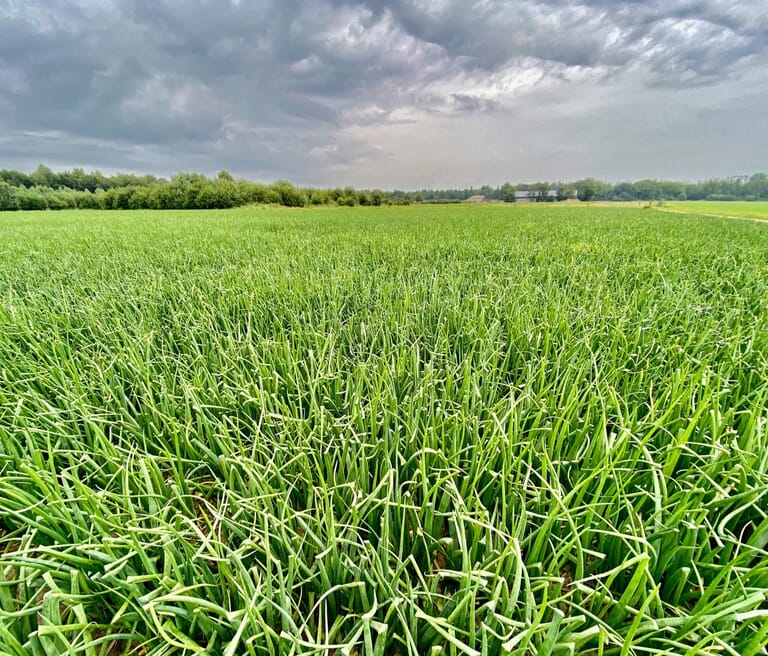
Contract farming: clarity on sales in advance
With contract farming, agreements are made in advance regarding the cultivation and sale of the seed onions. Examples include the variety, quantity, quality requirements, delivery terms, and the price or price determination. This ensures that you, as a grower, know exactly where you stand even before sowing. This can be attractive if certainty is important to you and you want to be able to plan your business operations well in advance.
A disadvantage is that you benefit less when the free market rises sharply later in the season. Conversely, a contract offers protection when the market comes under pressure. Contract farming is therefore often suitable for growers who want to hedge part of their risk in advance.
It is important not only to look at the agreed price, but at the full terms and conditions. What happens in the event of deviating quality, a lower yield, or changing market conditions? Anyone considering contract farming would do well to compare various agreements and assess what they mean for the ultimate return.
Want to know more about contract farming? Read on our page about contract farming how it works, what agreements are made, and what this method of sales can mean for you as a grower.
Onion pool: distribution and professional sales
An onion pool works differently. The onions from various growers are sold jointly, and the final proceeds are distributed among the participants according to the pool's agreements. Sales moments are determined throughout the sales season based on market opportunities. This means that as a grower, you do not have to choose one specific sales moment yourself.
This makes a pool attractive for growers who want to benefit from market movements but do not want to constantly be preoccupied with the timing of the sales themselves. Moreover, the result becomes less dependent on a single individual sales transaction. A pool can therefore help to spread the sales risk.
In practice, there are different types of pools, and the conditions can vary per pool. Therefore, do not look only at historical pool prices, but also at the way the pool is structured. Consider the duration, costs, risk allocation, quality requirements, and the method by which the yield is determined.
Curious how an onion pool works? Check out our page on onion pools and read how participation works and what choices you make as a grower.
Free trade: maximum freedom, but also more risk
With free trade, you keep the batch of seed onions free and decide for yourself when to sell. This can be immediately after the harvest, but also later during storage when you think the selling moment is more favorable. As a grower, this gives you maximum freedom to respond to the market.
This freedom primarily means that you decide for yourself when you want to take the market risk and when you want to lock in your yield. In a rising market, you can wait longer and potentially benefit from a higher price, while in a falling market, you also experience the consequences of the chosen selling moment yourself. The quality and storage possibilities of the onions also play an important role. A batch that is technically easy to store offers more room to postpone a sales decision.
On the other hand, storage entails costs and the market price can change during that period. Free trade therefore requires not only a feel for the market, but also sufficient financial leeway to postpone a sale.
A practical way to determine the sales strategy in advance is to set a lower limit. At what price or market situation are you willing to sell? This prevents a sales decision from being based solely on the expectation that the price will rise further.
More freedom in your sales? Read more about free trade and discover how you can keep your seed onions free and sell them at the moment of your choosing with PPA Group.
Contract farming, onion pool, or free trade?
The overview is, of course, a simplification. The precise conditions and risks vary per contract, pool, and market situation. Your own storage facilities, financial position, acreage, and desired level of certainty also play a role in the final choice.
PPA Group is familiar with the various sales methods from daily practice and can help you determine which approach aligns with your business and objectives. Would you like to know which sales method best suits your situation? Then contact PPA Group for a no-obligation discussion about contract farming, onion pools, and free trade.
Contract farming, onion pool, or free trade?
| Contract farming | Onion pool | Free trade | |
|---|---|---|---|
| Price known in advance | ✓ | – | – |
| Sales certainty | High | Average | Low |
| Moving with the market | Limited | ✓ | ✓ |
| Determine sales moment yourself | No | Limited | ✓ |
| Price risk | Lower | Diversified | Higher |
| Suitable for | Growers seeking certainty | Growers who want to spread risk | Growers who want maximum freedom |

Which sales format suits your company?
There is no single sales method that is the best choice for every grower. It is about the balance between security and freedom, between taking risks and spreading them. If you want certainty regarding part of the yield in advance, you can opt for contract farming. Those who prefer to organize sales jointly and spread out can consider an onion pool. And those who have sufficient financial resources, storage options, and confidence in their own market approach choose free trade.
Moreover, in practice, this choice does not have to be black and white. It can actually be beneficial to combine different sales methods within the company to spread the risk. In doing so, look not only at the expected price, but at the overall picture: yield per hectare, storage costs, financial resources, quality risks, desired security, and the time you are willing to invest in sales yourself.