What quality classes are there for seed onions?

From official quality classes to trade terms
To begin with, it is good to distinguish between the legal trade standard and the designations used in the onion trade. In the past, European regulations for onions recognized quality classes I and II. This classification no longer exists as separate EU quality classes. Nowadays, the general trade standard applies to onions. This stipulates, among other things, that onions must be whole, healthy, clean, and sufficiently dry, and that they must withstand transport and handling. Onions intended for industrial processing may, under certain conditions, fall outside the trade standard for fresh products.
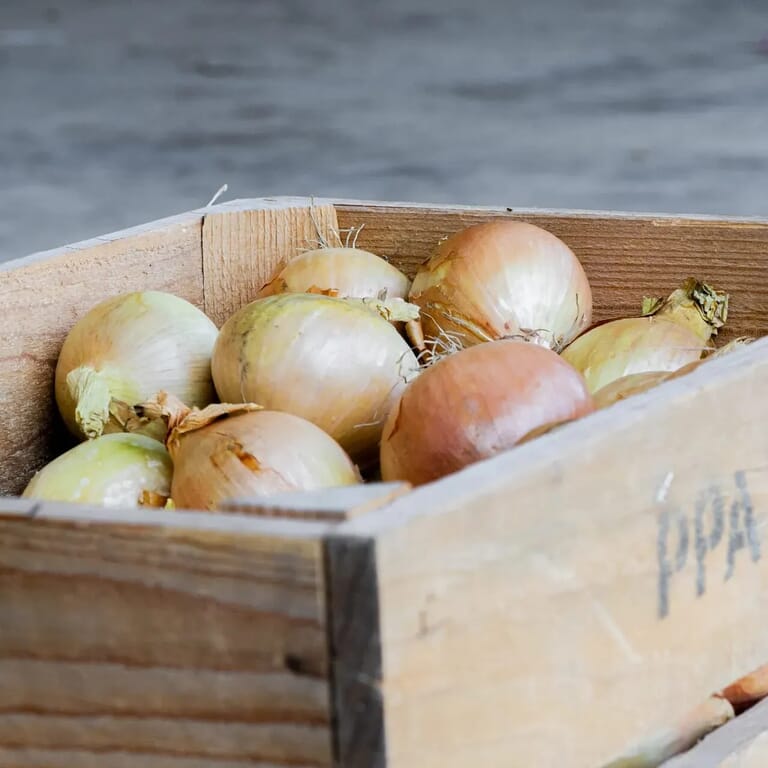
Nevertheless, Class I, Class II, and Industry are still widely used terms in daily trade. They primarily provide an indication of the properties for which a batch is suitable and the requirements a buyer places on the product. The old UNECE classification remains an important frame of reference in this regard. In this classification, Class I stands for onions of good quality with a neat appearance. Class II offers more leeway for, among other things, deviations in shape and color, minor damage, and skin abnormalities, as long as the onions retain their main characteristics.
What is a batch of seed onions assessed on?
Therefore, a batch is not assessed on a single characteristic. The combination of quality, size, skin firmness, shape, color, firmness, storage quality, and destination determines the best sales channel. The requirements of the end buyer also play an important role. View a handy overview here with characteristics and what is looked at per class.
Scroll to the right in the table to see all the information.
| Characteristic | Class I | Class II | Industry |
|---|---|---|---|
| Main focus | Appearance, quality, and presentation | Good usability with more room for deviations | Workability and yield |
| Firmness | Firm and solid | Sufficiently firm | Depending on the processing method |
| Skin/skin | Strong and well-groomed; minor superficial abnormalities permitted | More room for spots, cracks, and partially missing outer skin | External skin abnormalities are often less important |
| Shape | Typical of the variety, slight deviation permitted | More variation in shape permitted | Particularly suitable for machine processing; shape requirements vary per customer |
| Color | Slight color deviation allowed | More significant color deviation allowed | Appearance color often of secondary importance |
| Size | Depending on market and customer | Depending on market and customer | Often aimed at a size that can be processed efficiently |
| Shooting/germination | No visible shoot | Limited start of visible shoot permitted within the standard | Subject to application; customers may set specific requirements for this |
| Damage | Very limited | Light friction, healed bruises, and minor tears may be permitted | Superficial damage may be less severe |
| Suitable sales market | Fresh market and demanding buyers | Broad fresh market and sales with broader specifications | Peeling and processing industry |
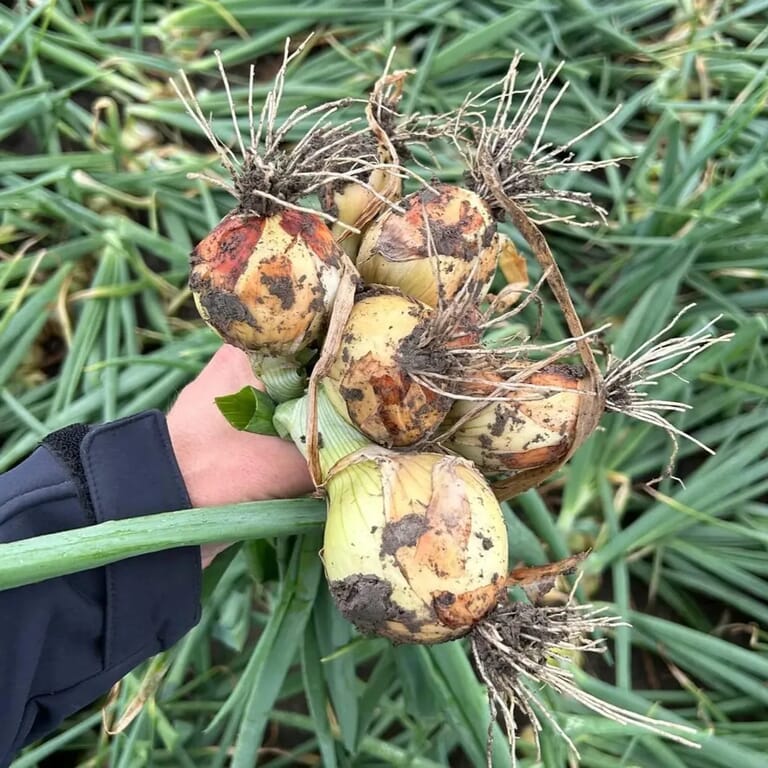
In Class I, the emphasis is therefore strongly on the appearance and presentation. The onions must be firm and solid, free from visible bolting and virtually free of root remnants. Minor deviations in shape or color are possible, as are limited superficial skin abnormalities.
In Class II, there is more leeway. For instance, deviations in shape and color are permitted, and under certain conditions, traces of rubbing, slight damage, healed bruises, root remnants, and a partially missing outer skin may occur. This does not mean that a Class II onion is of poor quality. The batch must still meet the minimum requirements and have sufficient quality and shelf life.
What role does the size of a seed onion play?
In addition to external quality, size sorting is an important aspect of the trade. Onions are sorted according to the UNECE system based on the largest cross-sectional diameter. The desired size then depends heavily on the market and the requirements of the buyer. Therefore, it is too simplistic to say that a certain size automatically corresponds to a specific quality class. A coarse onion is not by definition Class I, and a fine onion is not automatically Class II or industrial. The desired size is primarily a commercial specification. For example, the buyer may request a specific size due to packaging, the consumer market, processing, or the desired processing capacity. Size can also play an important role for the industry. In mechanical processing, the focus is on efficient processing and the highest possible yield. The desired size, shape, and internal quality differ depending on the application. Consequently, an onion that is less suitable for the fresh market in terms of appearance may actually be of interest to an industrial buyer. It is then less about a perfect exterior and more about the properties relevant to the specific processing process.
A deviation does not automatically mean an inferior destination.
One of the most significant misconceptions in the onion trade is that a deviation immediately means a batch is inferior. In reality, the main question is:
For which destination is this batch most suitable?
An onion with a beautiful, firm skin and uniform size can fit well within a demanding fresh market. A batch with somewhat more color or shape deviations can be perfectly suitable for sales where appearance is less important. And onions that do not meet the desired visual specifications for the fresh market can still be interesting for processing under the right conditions. That distinction is important: Class II is not a waste category, and industry does not automatically mean that a batch is ‘bad’.
For the trade, this means that a batch should not only be assessed on what it doesn't meet, but precisely on what is good about it. Quality, size, skin firmness, shape, storage quality, and destination must be considered together. This requires knowledge of both the batch and the market. At PPA, we therefore look not only at the class designation, but at the total profile of a batch and the question of which buyer fits it. From Class I and Class II to industry: the goal is to find a suitable destination for every marketable batch of seed onions. Do you want to know which sales channel best suits your batch of seed onions? Contact PPA. We will look at the quality, specifications, and market opportunities together.